
ASSET MANAGEMENT CONTROL
Every Asset.
Every Location.
Total Visibility
Standardised Tagging
Visual Floor Plan Overlays
Instant Traceability
Transform chaotic spreadsheets into precision floor plan overlays. Track equipment, furniture, and high-value assets with millimetre-accurate location mapping. Audit-ready in 48 hours.
THE CHALLENGE
From Auditor's Nightmare to Repeatable Protocol
The Asset Tracking Problem
Your finance team demands answers. Where’s the equipment? What condition? Who’s responsible? Spreadsheets fail. Systems don’t match reality
- Assets go missing with no location record
- Multiple conflicting spreadsheets
- Audits take weeks, not days
- No visual reference for physical locations
- Depreciation tracking disconnected from reality
- Maintenance schedules based on guesswork
The Ommateum Solution
Your building becomes the asset register. Every item tagged, mapped, and tracked on precision floor plans. One system. One truth.
- Every asset location shown on accurate floor plans
- Standardised tags linked to financial registers
- Visual audits completed in hours
- Real-time location updates when assets move
- Lifecycle tracking with condition documentation
- Automated compliance and reporting
OUR METHODOLOGY
Three Steps to Complete Control
We build the system. You maintain visibility forever.
Define Tagging Schema
We design the structured framework for organizing and labeling your assets consistently across your entire operation.
- Asset categories & classifications
- Unique identifier formats
- Financial register alignment
- Location referencing system
On-Site Asset Tagging
Our surveyors capture every asset with LiDAR-accurate location mapping and comprehensive data collection.
- Physical tagging with unique IDs
- Category, value, warranty capture
- Condition assessment & photos
- Precise floor plan positioning
Visual Asset Registry
Receive interactive floor plans showing every tagged asset with full data integration and audit trails.
- Layered floor plan overlays
- Searchable asset database
- Export to financial systems
- Ongoing update protocols
Comprehensive Documentation
Every Data Point That Matters
We capture the information you need for financial planning, maintenance scheduling, and compliance reporting.
Category & Type
Classify assets by function: electrical, HVAC, fire safety, furniture, IT equipment, machinery.
Purchase Value
Original cost documentation for budgeting, depreciation calculations, and replacement planning.
Warranty Information
Track warranty periods and expiry dates to reduce repair costs and optimize replacement timing.
Condition Assessment
Current state documentation to inform maintenance priorities and lifecycle management decisions.
Exact Location
Millimetre-accurate floor plan positioning with room, zone, and grid reference coordinates.
Lifecycle Tracking
Installation dates, maintenance schedules, inspection records, and replacement projections.
Standardised Tag – for asset type, condition, owner, cost centre, depriciation class and location
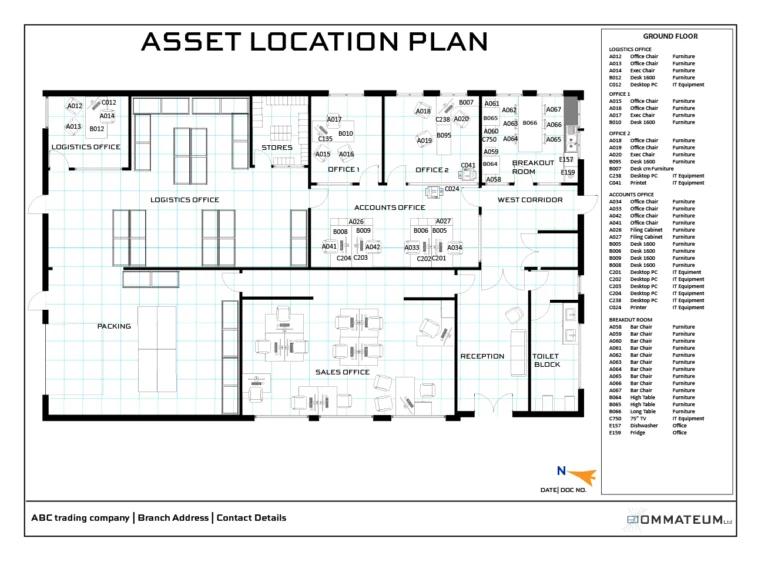
Floorplan Overlays – Auditors can see exactly where every asset lives
Instant Traceability – for moves, replacements and lifecycle changes.
Audit Ready Records – all aligned with your financial registers and controls.
THE IMPACT
Beyond Tracking: Strategic Advantage
Instant Audits
Complete asset audits in hours instead of weeks. Visual verification against floor plans eliminates manual searching.
Financial Accuracy
Depreciation schedules aligned with real-world asset locations and conditions. No more phantom assets on the books.
Optimised Maintenance
Schedule servicing based on actual asset locations and usage patterns. Reduce downtime and extend equipment life.
Data-Driven Decisions
Replacement budgets backed by real condition data. Space planning informed by actual equipment footprints.
Reduced Losses
Missing assets identified immediately. Equipment moves tracked and documented. Accountability enforced
Compliance Ready
Insurance audits, financial inspections, regulatory reviews, your asset register passes every time.
APPLICATIONS
Who Benefits from Visual Asset Control?
Facility Managers
Track HVAC, electrical, and building equipment across multiple floors and zones.
Finance Teams
Verify physical assets match financial registers for accurate depreciation and budgeting.
Hotel Groups
Furniture, fixtures, and equipment tracking across rooms and common areas.
Educational Facilities
IT equipment, lab instruments, and classroom furniture across campus buildings.
Healthcare Settings
Medical equipment, patient furniture, and critical system components.
Retail Chains
Stock control systems, POS equipment, and display fixtures across locations.
COMMON QUESTIONS
Asset Tagging FAQs
An asset tag is a unique identifier assigned to a physical item (desk, chair, monitor, fire panel, HVAC unit, etc.). It allows the item to be tracked, audited, and referenced consistently across floor plans, financial registers, and operational systems. Think of it as a permanent ID card for every piece of equipment you own.
Tagging assets directly on floor plans provides a visual reference for exact locations, enables faster audits and compliance checks, creates a single source of truth for facilities, finance, and operations teams, and reduces confusion when multiple similar items exist. It’s the same principle architects use for symbols and room tags, but applied to operational asset management.
Tags follow a simple, consistent format tailored to your needs: category-based (A01, A02, A03), room-based (R01-01, R01-02), or grid-based using floor plan coordinates (B3-01). The goal is clarity, not complexity. Each tag should instantly tell you what the item is and where it belongs. We design the schema during step one of our process.
Yes. When an asset is moved, the tag stays with the item (not the room), the Asset Legend is updated to reflect the new location, and the floor plan is revised during the next update cycle. This keeps the system consistent and avoids duplicate tags. We can provide quarterly, immediate, or annual update services depending on your needs.
Update frequency depends on your operational needs: quarterly for general updates, immediately for compliance-critical changes, or annually for full audits. This ensures the plan stays accurate without creating unnecessary administrative overhead. We’ll work with you to establish the right update protocol during implementation.
Initial asset tagging and floor plan creation takes 3-7 days depending on building size and number of assets. Schema design (1-2 days), on-site survey and tagging (1-3 days), data processing and floor plan creation (24-48 hours). You’ll receive digital floor plans, searchable asset database, and integration files for your financial systems.
Ready to See Every Asset?
Transform your asset management from spreadsheet chaos to visual precision in under a week.